

Berry AI CEO Eric Lam took the stage at the FS/TEC 2026 Innovation Forum with Sean Thompson, VP of IT at Freddy's Frozen Custard & Steakburgers, for a session about one thing only: using cameras and AI to identify people, vehicles, and objects in restaurants.
These days, every single vendor has some AI. The harder question for operators is which vision AI projects are actually ready to deliver, and which vendors can deliver them.
Eric opened by promising to pass on seven years of vision AI experience in about 15 minutes. What he shared was less a product pitch and more a checklist: three tests for choosing a use case, three ways to vet a vendor, and two lessons from the field that had nothing to do with the technology.
Here are the highlights.
Vision AI has a lot of use cases. Not all of them are ready.
Eric started with a quick map of where cameras are already being pointed in QSR, using public examples:
- Hold times. Chipotle and Chick-fil-A have announced projects using cameras to watch food bins and know when to cook or replenish.
- Inventory counting. Starbucks famously announced a project that used 3D depth-sensing cameras on a handheld tablet to count stock.
- Speed of service. Tracking every vehicle in the drive-thru from the moment it enters the line to pickup. This is what Berry AI specializes in.
- Loss prevention. Auditing refunds and discounts, for example flagging a refund when no customer is at the counter.
- Order accuracy. Checking what goes into the bag, for drive-thru guests and for fighting 3PD delivery disputes. Eric called it the holy grail of computer vision.
Some of these are mature. Some are still early. So the first decision any operator makes is which one to start with.
Three tests before you pick a use case
1. What accuracy does the use case require? Even a best-in-class AI is going to make mistakes, so Eric encourages operators to ask what happens when it gets something wrong. If a speed of service system times one car a little long or a little short, that is not life and death. A real-time order accuracy alert that stops the expo line and turns out to be wrong a couple of times a day is a different story.
Imagine doing pay-by-license-plate and you're only 95% accurate. Every 100 guests, you're going to get five charged the wrong amount or charged the wrong person.
His advice: ask whether you can live with 95%, and start with the use cases where you can. Those are the lowest-hanging fruit.
2. Can the camera actually see it? The beauty of vision AI is that seeing is believing. The catch is occlusion. If the only difference between two bottles is one word on the label and a crew member's hand covers that word, there is no way the camera can tell them apart. The same goes for a small sauce packet inside a closed hand.
If the camera cannot see it, it cannot identify it.
That is why requests like "Can you tell if someone is on their phone?" or "Can you tell if someone washed their hands for 30 seconds?" need an occlusion check first.
3. How much does what you are detecting vary? Computer vision works best on standardized things. Fried chicken looks slightly different piece to piece, and the color can shift with an oil change. If your packaging changes every three months, the model has to be retrained every three months. The more objects you need to identify, the harder the use case.
Three ways to vet a vision AI vendor
Run a reference check. AI often works behind the scenes, and it is hard to look inside the black box. Eric's biggest piece of advice to any operator is to talk to the vendor's existing customers.
There's no way to cheat or no way to kind of fumble your way through a live deployment, and if it's delivering value, it'll come through very clearly in a reference check.
Ask for proof that it works in real time. Before Berry AI, Eric worked in autonomous stores. In the early days of that space, shoppers might get their receipt 30 minutes, 60 minutes, or even two hours after leaving, and the more items they took, the longer it took. The reason: people somewhere were reviewing the video manually. Real time is how you know it is really AI.
There's no minion hiding behind the background that's doing this manually.
Pilot in your most visually diverse stores. Operators often pilot with their most engaged general managers or the stores closest to headquarters. Eric recommends the opposite. For drive-thru timing, that means lanes with trees and without, single and double lanes, and lots with parking in the middle. For inventory counting, it means storerooms that are bright, dim, and cramped. Everything looks great on a deck and in a friendly pilot. The goal is to test the system to its limits.
What this looks like in the drive-thru
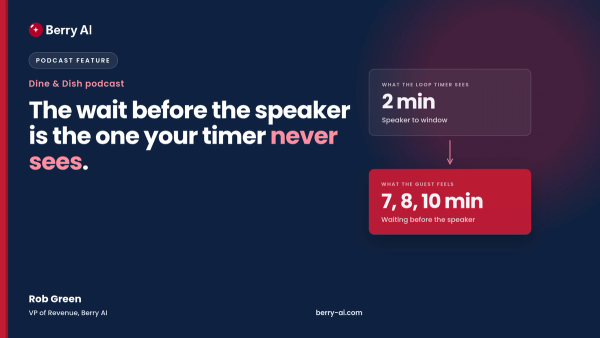
Eric walked through Berry AI's own use case as an example. Traditional loop timers record a time at the sp eaker post and a time at the window. That misses what the guest actually experiences, and the loops are easy to game, whether by pulling cars forward or waving metal bins over the sensor.
Seeing is believing. It's very difficult to cheat a camera system.
A camera-based timer follows each car from the moment it starts queuing, through ordering, to picking up the food, and keeps tracking it even when it is pulled forward. The output is a real-time dashboard in the store, and by design it does not look like AI at all.
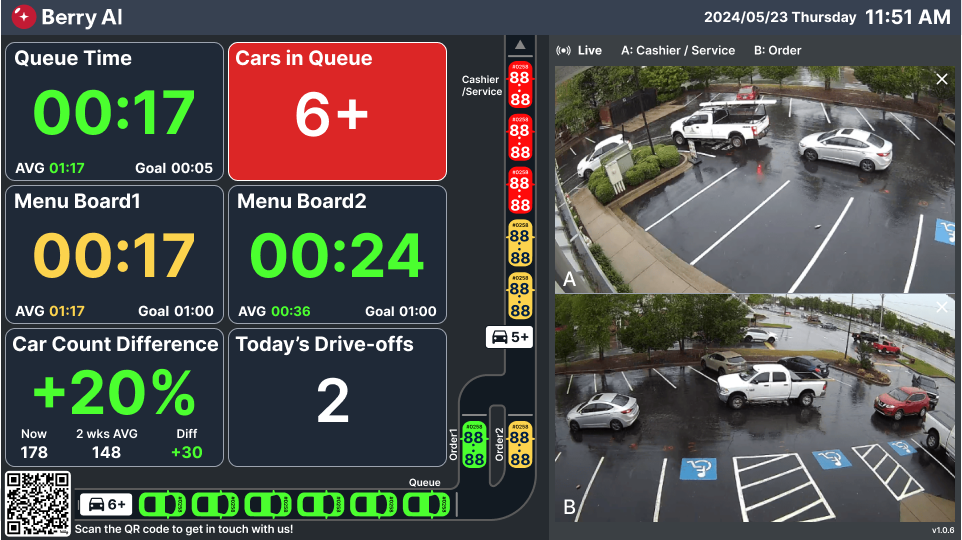
AI is a tool. It is not the end goal. The end goal is to solve whatever problem you're trying to solve.
However complex the AI is underneath, the output has to be as simple as possible. As Eric put it, all of the complicated AI needs to dissolve away.
The two hardest lessons were not technical
Eric shared two challenges from a deployment with a very large customer. Neither was about the model.
Too much information cost trust. General managers loved the cars in queue metric. They no longer had to send someone to the window to see how far back the line went. So Berry's engineers went further and used cars in queue plus historical sales to tell stores how many batches of fries to drop. That quickly backfired. One manager's reaction:
I don't need Berry to tell me how many fries I should be dropping. I've done this for 15 years. I know.
Berry stepped back, gave managers the cars in queue number, and left the decision to them. Adoption went much better.
The screen has to match what the crew sees. When line-busting tablets took an order early, Berry moved that car to the next status, even though it was still physically sitting behind the menu board. Staff could see the car with their own eyes, did not see it on the screen, and assumed there was a bug. Berry switched to showing every car where it actually is in the lane, much like the little cars a Tesla shows on screen in self-driving mode. Small design choices like that are what help people believe in the system.
17% faster across hundreds of stores
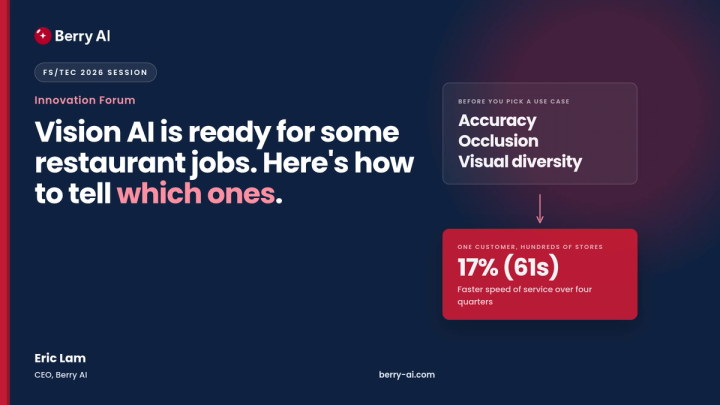
Eric closed his presentation with results from one customer that deployed Berry AI in hundreds of stores. Over four quarters, they improved speed of service by 17%, or 61 seconds.
We don't claim credit for all of this. We put in a really accurate timer, but that helps our customers identify the path forward to really drive improvement.
His takeaway: at least some vision AI use cases are ready to make an impact today.
From one use case to one platform
Looking ahead, Eric sees vision AI vendors evolving from single use case companies into platform companies, offering more and more use cases on the same set of cameras.
That is the path Berry AI has followed. Customers did not want two camera systems, one for the drive-thru and one for security, so Berry's second product was video surveillance inside the restaurant. With those cameras in place, the focus has turned to loss prevention, such as checking whether refunds and discounts were used properly, and to retrieving video quickly so restaurants can fight 3PD disputes where they are losing money for mistakes they did not make. From the drive-thru, Berry is expanding into the kitchen and the dining room.
Watch the full session
The full session also covers audience questions on 360-degree cameras and people counting for per-person averages, and a conversation with Sean Thompson on checking cultural fit alongside the technical boxes, watching the cost of running AI, and why artificial intelligence still does not have wisdom.
Watch the FS/TEC 2026 session.
Book a demo at berry-ai.com/demo.