

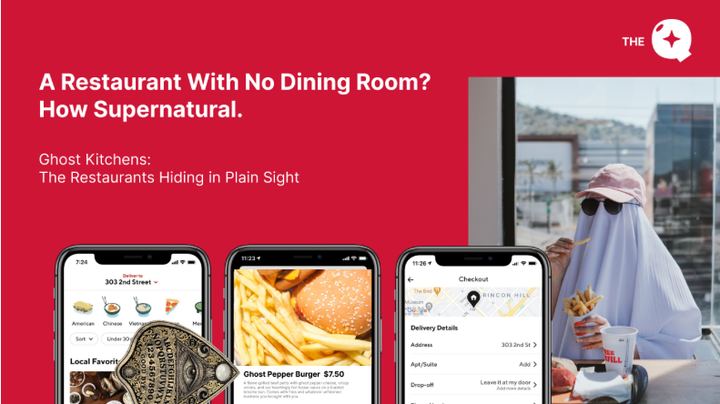
You found a new wing place on your delivery app. Great name. Good photos. You’re already emotionally committed to the fries. Then you look up the address.
Wait. Isn’t that a Chili’s?
Welcome to the world of ghost kitchens and virtual brands, where the food is real, the kitchen is real, and the restaurant you pictured may be a little… less physically present. (Very seasonal of them.)
Some are familiar brands operating out of delivery-only kitchens. Others are separate online brands sharing a kitchen with a restaurant you already know. Different setups, same basic idea: sell the food without opening another traditional restaurant.
For QSR operators, the appeal can make sense sometimes. Reach more customers. Test a concept. Put existing kitchen space to work. But taking the dining room out of the equation doesn’t make the costs, or the operational headaches, vanish.
So, in the Halloween spirit, let’s see what’s actually haunting the delivery menu.
First, what exactly is a ghost kitchen?
Before we call an exorcist, let’s establish who’s making the burritos.
The terminology gets messy because “ghost kitchen” often gets used to describe both a physical kitchen and the brands selling food from it. Here’s a useful distinction:
A ghost kitchen is the operation. It prepares food primarily for delivery, without a traditional dining room. Depending on the setup, it may also handle pickup or catering. It can serve one brand or several, with the cooking handled by the brand’s own team or another operator.
A virtual brand is the restaurant identity. It has its own name, menu, photos, and online presence, but it can operate inside an existing restaurant.
Imagine a local diner launching “Midnight Breakfast Burritos” on a delivery app. Different branding than their physical location, with a focused menu and the same kitchen making the orders. That’s a virtual brand. The diner hasn’t become a delivery-only kitchen, and nobody has built a second restaurant.
There are also shared commercial kitchens where separate food businesses rent space. A big distinction however, sharing an address doesn’t necessarily mean sharing cooks, ingredients, or ownership.
Those are pretty striking differences. Adding a menu to an existing kitchen and opening a dedicated delivery facility come with varying commitments.
So, how did we get here?
Someone invited delivery apps in, and now the kitchen’s haunted.
Delivery-only kitchens were taking shape well before the pandemic. Deliveroo launched its Editions kitchen model in 2017, giving restaurant brands a way to reach new areas without opening a conventional restaurant (JLL, 2018).
The rise of delivery apps also helped make the model possible: customers could discover a restaurant through a screen, without ever walking past its front door.
Then the pandemic drastically accelerated the appeal. With dining rooms restricted and operators looking for ways to generate sales, delivery offered an outlet, and existing kitchens offered somewhere to start.
The change in ordering behavior was dramatic. DoorDash’s total orders more than tripled in 2020, rising from 263 million to 816 million as dining-room shutdowns and shelter-in-place measures accelerated adoption. (DoorDash, 2021)
With all that in play, we’ll be real, the pitch was compelling: expand your reach without replicating every part of a traditional restaurant or putting employees at risk. The results, however, depended on what happened behind that missing front door.
The algorithm summoned dinner
Your favorite influencer is haunting a kitchen near you.
While delivery apps were changing how people ordered food, social media was ramping up to change what made them want it. (We’ve talked about this before, does anyone remember the infamous grimace shake?)
A dish could become something you recognized before you’d ever tasted it. You’d watched someone make it, review it, or pull it apart on camera. Ordering it meant getting a taste of something you’d already been following.
Virtual brands gave that attention somewhere to go. (And, frankly, a way to funnel in revenue.)
In December 2020, MrBeast Burger launched through roughly 300 existing kitchens (Restaurant Business, 2021). A creator with an established audience could introduce a food brand across the country, with local restaurants preparing the orders. Fans knew the name on the bag and the runway was short to sell out these new locations.
The connection to TikTok eventually became literal. In 2024, Virtual Dining Concepts introduced Creators’ Kitchen As Seen on TikTok, a virtual brand featuring a rotating menu inspired by viral dishes (Restaurant Business, 2024). We now saw a direct path for customers watching food content on their phones to order them straight from a ghost kitchen.
Elsewhere, food businesses were borrowing the anticipation of a product drop. Concepts like Chain used Instagram to announce limited food releases, giving followers a reason to pay attention and act before they missed out (Fast Company, 2021). These weren’t all ghost kitchens, but the marketing appeal was related.
The flow: A specific, limited dish, a moment of excitement, and a clear way to get it.
(Can we say the McRib walked so the MrBeast Burger could run?)
For restaurants, the possibilities extended beyond celebrity partnerships. A focused concept could give an existing menu item its own identity, whether that meant breakfast burritos, late-night burgers, or wings that customers might never have searched for under the original restaurant’s name.
Seen through that lens, virtual brands became a way to experiment with positioning as well as food. The kitchen could stay in place while the name, audience, and occasion changed. A restaurant no longer had to be somewhere you’d walked past. It could be something you scrolled to and followed.
Meet the ghosts on your delivery app
Chili’s in disguise. KFC without a dining room. Wendy’s retreat from the spirit world.
With all of that proof on socials, it’s not surprising that some ghost kitchens wear a shockingly familiar face (or hide under a mask). However, could this trend be short lived? Some big brands have already decided to leave the seance.
- KFC kept the Colonel and lost the dining room.
- In 2022, KFC announced a “delivery-only kitchen” trial beginning in London. Customers would order KFC through delivery platforms or its own website and app. The experiment focused on extending access to an established brand, rather than creating a new restaurant identity.
- The goal was to extend the brand’s reach without opening another conventional restaurant. As James Whitehorn, then chief development officer for KFC UK & Ireland, explained: “This launch presents an opportunity for us to reach more people than ever.” (City A.M., 2022)
2. Chili’s had a secondary identity.
That wing place from our opening? There’s a reason the address looked familiar.
Brinker launched It’s Just Wings in June 2020 from 1,050 company-owned restaurants, using the kitchens behind Chili’s and Maggiano’s to give a focused wings concept its own name and delivery presence. (Brinker International, 2020)
The opportunity was already inside its restaurants: kitchens, equipment, and staff that could support another concept without another buildout. Then-CEO Wyman Roberts framed it as a response to concerns that casual dining had too many restaurants: “We believe this is our opportunity to prove that maybe it isn’t overbuilt, it’s just underutilized.” (Nation’s Restaurant News, 2021)
In its first year, It’s Just Wings generated $170 million in U.S. sales across company-owned and franchise locations: a substantial debut for a brand built inside restaurants that were already there. (Brinker International, 2021)
3. Wendy’s had an ambitious plan. Then came the exorcism.
In 2021, Wendy’s and REEF announced plans for 700 delivery kitchens across the U.S., Canada, and the U.K.
Abigail Pringle, then Wendy’s president, international and chief development officer, pointed to the need to expand beyond conventional locations: “The demand for convenient delivery solutions means we must look for opportunities beyond our traditional restaurant formats, especially in dense urban areas.” (Wendy’s, 2021)
The partnership ran into problems beyond finding hungry customers. In 2022, Wendy’s reported that its U.S. REEF locations were generating less than $500,000 in annual sales per unit. REEF wanted to operate multiple brands from each kitchen to improve productivity, while Wendy’s wanted kitchens dedicated to its own brand. Permitting difficulties also complicated openings. (Restaurant Business, 2022; Nation’s Restaurant News, 2022)
By 2023, Wendy’s had stepped back from the expansion strategy and announced plans to close its remaining U.S. REEF kitchens, a reminder that the brand and the kitchen operator still have to agree on what makes the business viable. (Restaurant Dive, 2023)
Turns out “Do ghost kitchens work?” is a difficult question to answer broadly.
The appeal: more possibilities from the kitchen
Why operators are summoning new concepts.
For an operator, several opportunities are worth exploring.
Test a concept with a smaller commitment. A focused delivery menu can help assess demand before committing to a full restaurant buildout. It still requires investment, but the scope of the experiment can be smaller.
Reach a different customer. Someone searching for wings may scroll past a general restaurant menu. A dedicated concept gives that offer its own identity and a clearer reason to show up in the search.
Put available capacity to work. An existing kitchen may have equipment, ingredients, and quieter periods that could support additional orders. A compatible menu can make better use of resources already in place.
Extend delivery coverage. A dedicated kitchen can put an established brand closer to customers outside its existing delivery area.
This all starts with a practical question: what can this particular kitchen support?
The catch: the workload is very much alive
The headaches don’t die with the dining room.
A new listing can look simple enough from the customer’s side. Inside the restaurant, every order still needs that same operational checklist: ingredients, preparation, packaging, and a successful handoff.
Here’s a handy list of very real roadblocks that can arise:
The costs keep coming. Delivery commissions, promotions, packaging, waste, and additional labor all belong in the calculation. A smaller footprint doesn’t automatically produce a healthy margin.
Available capacity changes by the hour. A fryer that sits idle at 3 p.m. may be the bottleneck at 7 p.m. If the new concept competes with the core business during its busiest period, both experiences can suffer.
Another brand needs attention. Its menu, photos, positioning, reviews, and customer questions require ongoing work. A separate name doesn’t create demand on its own.
The food has to survive the journey. Packaging, preparation timing, driver wait, and travel time shape what arrives at the customer’s door. The menu needs to work beyond the pass.
Customers need clarity. A virtual brand can have a distinct identity while being clear about who prepares the food. Discovering a shared address shouldn’t feel like solving a restaurant mystery.
What gives a ghost kitchen staying power?
Even ghosts need good bones.
For operators considering the model, the strongest starting point is a defined job for the kitchen. Some can find success in testing demand in a new neighborhood, or selling a complementary menu during a quieter part of the day.
From there, the evaluation needs to get concrete:
Does each order contribute enough after its associated costs?
Can the team handle the workload during the hours customers actually order?
Does the menu fit the equipment, ingredients, and skills available?
Can customers and drivers collect orders without confusion?
Is the concept bringing in additional business?
Will the food arrive in a condition that earns another order?
Will ghost kitchens stick around enough for QSR to care?
The pandemic gave ghost kitchens a captive audience, but whether they can keep growing now that customers have every reason to leave the house is a more interesting question.
The pullbacks we’ve covered suggest that enthusiasm for opening delivery-only kitchens ran ahead of what some operators could sustain. Meanwhile, the platforms where customers discover them continue to grow. DoorDash reported 970 million total orders in Q2 2026, up 27% from a year earlier, or 17% excluding its acquisition of Deliveroo. That includes its international, grocery, and retail business, though the company also reported slightly accelerating growth in its U.S. restaurant order value. (DoorDash, 2026)
Those numbers don’t tell us whether ghost kitchens themselves are growing, but they give us a reason to question the idea that their opportunity disappeared when dining rooms reopened. Customers can want the experience of going out and still want something new delivered on a Tuesday.
For QSR, the question is how much of that appetite leaves room for brands customers may never encounter beyond an app and whether those brands can become part of someone’s routine after the novelty wears off.
Do you see ghost kitchens becoming a lasting part of QSR, or were the pandemic conditions that helped them take off also their best chance to succeed?