

Berry AI VP of Revenue Rob Green joined Michele DiMeo on the Dine & Dish podcast to talk about the part of the drive-thru loop timers never see, how to put the right data in front of each role, and why AI is a tool, not a magic bullet.
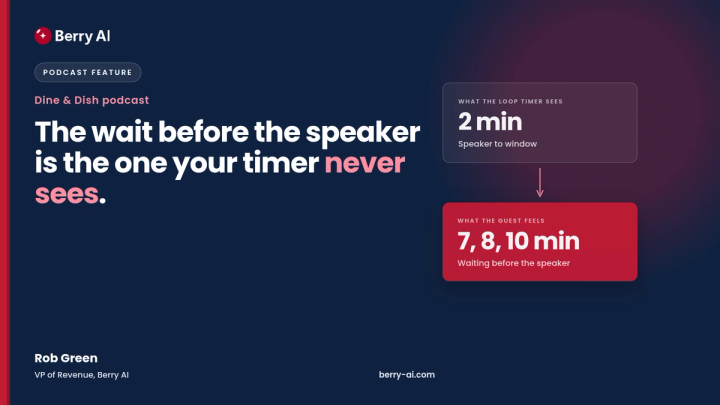
Most guests are not impressed that their time from the speaker posts to the window was only 2 minutes. They are mad that they waited 7, 8, or 10 minutes before they even got to the speaker. Then they leave.
That wait is often invisible to the restaurant. The loop timers buried in the asphalt only measure menu board to window, a tiny percentage of the customer journey, even though the drive-thru often represents 70% of revenue.
That gap was the starting point when Rob Green, Berry AI's VP of Revenue, sat down with Michele DiMeo on Dine & Dish. Over 51 minutes they covered what actually happens in the pre-menu queue, how one location unlocked $15,000 in revenue per week by moving a single person, how data should be split among the crew, the manager, and the brand, and where privacy lines should sit.
Here are the highlights.
The guest clock starts before the speaker
For years, speed of service has been measured by magnetic loops under the pavement, from the menu board to the window. Rob's point is that this is not the wait the guest is counting.
When you and I go through a drive-through, we're not so excited that our time was only 2 minutes between the speaker posts and the window. We're mad that we waited 7, 8, 10 minutes before we even got to the speaker and we leave.
What Berry AI's camera systems do, Rob said, is give operators visibility into the entire journey so they can make better strategic and operational decisions. The queue before the speaker is part of that journey. Loop timers never see it. Guests do.
One move, and $15,000 a week that the POS never showed
One brand-level customer already knew their loop timers were giving them limited visibility. At one location, the cameras showed a choke point before the menu board, and cars were driving off. The POS and the loop timers could not tell them that.
Once the store had that visibility, the team shifted one person inside the restaurant to a different spot, into the kitchen to help with prep, and they unlocked 15,000 revenue per week.
The same picture of the lane also changes what the crew does in the moment. Some operators watch how many cars are in the pre-menu queue and have already decided what that number means. As an example, Rob said, when there are six cars they know they can start dropping fries before a tablet order taker even goes out. They also know they will lose one or two of those guests if they do not send another tablet taker now.
Give each team only the data that matters for their job
A report that helps a VP of operations can overwhelm a window cashier. Rob said Berry breaks the data into three groups.
Frontline teams get real-time data on a dashboard, with simple icons and graphics, so they can make decisions in the moment from the most relevant point: for example, six cars in the pre-menu queue, so send out a tablet order taker. Managers get more enriched data as an email report: what happened today, what the trend is this week, and what decisions that should change. At the brand level, Berry provides a much deeper set of data, so teams can look at a menu item, its speed-of-service correlation, how an LTO is affecting sales, or how much was lost because of throughput.
He compared it to lab results. When you get blood work back, there are many data points that are not relevant to you. The physician points you to the ones that matter now. The doctor may see more than the patient does. We tried to provide them with just the data points that they feel are most salient to them for their role of responsibility. The person taking payment at the window does not need to know how an LTO performed across a region. The corporate data team and the VP or chief of operations do.
AI is a tool, not a magic bullet
Some operators, Rob said, think that buying the next new tool will solve their problems. That's not the way it works. The starting point is to understand what you are trying to achieve and pick the right tool for that job. If the goal is to make more of the traffic you are already getting and convert it into revenue, that's particularly where we play.
People who buy into this notion that AI is this magic bullet that's going to solve all of my problems. What they're really doing is they're losing money and they're compounding their frustration over time.
The data can also push in an unexpected direction. Operators often hope AI will reduce headcount. In some areas it can, Rob said, but in some areas we've actually seen where it helps inform when you need more headcount. One system counts people at the counter, how long they stand in the lobby, and how many walk out. Stores were able to see there were not enough people at the registers, and to quantify how many guests left. In that case, the AI is actually driving increased head count, but it's commensurately increasing revenue and profit.
His closing advice was about choosing the right tool. If you want to hand-carve a statue out of granite, you can do that and create a Michelangelo, but it will take a long time and a steep learning curve. If you want to get high quality results faster, use the right tool for what the job is and trust the tool to do what it's supposed to do.
Too many people just think, I can do this by hand or I can keep using loop timers. You can, but you're going to be leapfrogged by people who adopt the quality data tools much faster.
Privacy by design: no faces, no plates by default
Asked about privacy, employee pushback, and what happens if systems are hacked, Rob pointed to a decision Berry made on purpose: We as a company have intentionally made the decision. We do not track faces. The cameras may see a face, but Berry is not storing that video feed and is not applying its AI models to the identification of someone's face. License plates are not tracked by default either, unless a brand explores that as part of an opt-in loyalty app.
Data is encrypted at rest and encrypted in transit. For the drive-through system, video only transfers long enough to get trained, then we actually dump the video feed. The loss-prevention system is a little different, but Berry still does not apply AI to de-anonymize anyone's face.
Accuracy first, then speed
In the lightning round, Michele asked: speed or accuracy? Rob did not hesitate.
Ultimately, accuracy. It doesn't matter how fast you are if you're wrong, but if you've got it right, then speed is the next effort multiplier, result multiplier.
That applies to the data as well as to the order. Routine audits are just part of data hygiene. Over time, operators can get to a comfort level where the numbers are accurate enough for what they are trying to do, and that accuracy continues to increase over time. What the industry is not ready for yet, he added, is using cameras to check item-level order accuracy, such as how many pickles went on a sandwich. The technology is not there yet, not just for Berry, but industry-wide. There are better ways to solve that problem today.
Watch the full episode
There's much more in the full conversation, including how hospitality still commands a premium even as some guests want no human interaction at all, how mobile-order lanes can be measured separately, and why a kiosk works better when a person is still there to guide the guest through it.
Watch the episode on YouTube.
Book a demo at berry-ai.com/demo.