

Berry AI CEO Eric Lam joined Andy Grindstaff on the Restaurant Reset podcast to talk about why drive-thrus have been measuring speed of service wrong for decades, and what operators see when they finally measure the whole guest experience.
Most drive-thrus are proud of a number like 2:38 from menu board to window. Most guests, especially at lunch, would tell you they waited a lot longer than that. Both are telling the truth. They are just measuring different things.
That gap was the starting point when our CEO, Eric Lam, sat down with Andy Grindstaff on the Restaurant Reset. Over 44 minutes they covered the metric operators should actually watch, how to roll out cameras without turning data into a blame game, where privacy lines should sit, and what breaks when you take computer vision from a pilot store to a thousand restaurants.
Here are the highlights.
Two points on the pavement don't tell you what the guest experienced
For decades the drive-thru clock has been a wired loop buried in the pavement, timing the trip between two points: the menu board and the window. As Andy pointed out, crews have learned to game it, waving metal trays over sensors or pulling cars forward into a parking spot so the clock stops while the guest keeps waiting.
The bigger issue is what two points leave out. Eric recommends operators watch two numbers. The first is throughput, set by whichever step in the lane takes longest (often the window). "Going from 60 seconds to 55 seconds alone will bring significant extra traffic to your restaurant." The second was never available from loop timers:
"What we call the total experience time. So, end to end, the moment a customer shows up in your lot to them getting their food, how long did they wait? We believe that truly captures what the customer is going through. And that's what you should be optimizing around."
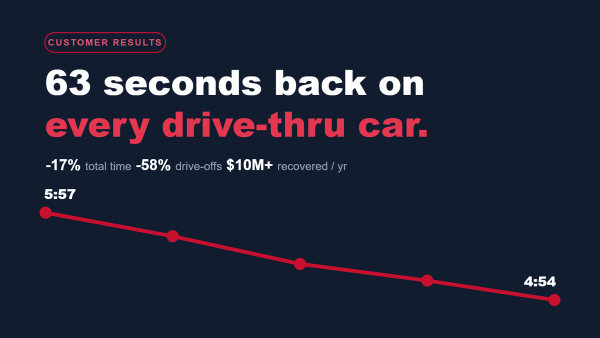
Andy calls it the true speed of service. If it runs long, you get drive-offs and lost revenue that never shows up in the old report.
Trust first, then the reports
Eric described two moments when an operator first sees the drive-thru through cameras. The first is verification: the monitor turns on, the crew sees five cars in the queue, pokes a head out the window, and confirms there are five cars. "For any operator to act on any data, they have to really believe in it."
The second moment arrives with the first weekly reports, and it is often the bigger surprise. Multi-unit operators expect similar-volume stores to have similar wait times. In reality, the gap between them can be 20%, 30% or even higher. That's uncomfortable, but it is also the clearest map of where to improve.
How to keep data from becoming a blame game
New visibility can make people defensive, especially when bonuses ride on the old number. Eric was candid that Berry AI's early product leaned too hard into recommendations, such as telling a GM how many burgers to cook because there were 10 cars in the queue. Crews felt that encroached on decades of operating experience.
The fix was balance: give the team the information and let them make the call. When a store pushes back that its lane is shorter or laid out differently, Eric goes back to the guest: "At the end of the day, the customer doesn't care whether your drive-thru is a different layout than that one. They just care how long they're waiting."
Most of the time, he added, the data confirms what ops leaders already suspected. "I've always had a hunch about X or Y or Z, but I've never had the data to back it up."
The bottlenecks are usually operational, and fixable
What do the cameras surface most often? Usually it's labor positioning: crew washing dishes at peak while the kitchen is slammed, or pre-rush prep steps that weren't completed before lunch. Andy shared one example from an operator whose drive-thru was trending about 10% below the prior year. The cameras showed guests sitting at the speaker post for more than 90 seconds at peak. Adding a second order taker before the lunch rush closed most of that gap.
As Eric put it, these problems are exciting "because they're easy to fix. And once you fix them, you bring incremental traffic and margin to your restaurant. That doesn't require extra labor."
Lab, real restaurant, a thousand restaurants
"Computer vision is the type of technology where it's easy to get it set up in a lab environment, much harder to get it working in a real operating restaurant, and much, much harder in a thousand."
At scale, the challenge is what Eric calls the long tail of edge cases. Berry AI has deployed in drive-thrus converted from car washes and banks, and in lanes where a tree with no leaves at install time blocks the view once summer arrives. Handling that visual diversity, he said, is "really a way that different vendors can showcase how mature their technology is."
The other half is operational. "Berry is not just a great technology company. We actually have to be a great operations company as well." Creative cable runs, optimal camera angles and AI trained to be resistant to what it sees are what make the system work out of the box. Operators can reuse existing security cameras to lower upfront cost, with a trade-off in visibility. Many choose new drive-thru cameras for full coverage and a more future-proof system.
Privacy by design: replace the loop timer, nothing more
Asked how to avoid the "Big Brother" perception, Eric explained a decision Berry AI made on day one. "We're here to replace the loop timer... We don't keep any of the videos." Today the system does one simple thing: it measures drive-thru wait times, discards the video, and uploads the data so operators can make better decisions.
Looking ten years out, he expects cameras to handle most routine visual checks a GM does today ("the cameras will be the eyes") so staff can spend their time elsewhere. What cameras should never do is micro-measure people: "At the end of the day, we're designing human systems, and no one wants to be treated in a micro-measured, privacy-invading way."
Where this goes next
Berry AI started in the drive-thru because it was the right first use case. It is valuable without needing "six nines of accuracy." This year the company moved inside the restaurant, after customers asked for one central camera system instead of separate drive-thru and security setups. Once every camera is connected, Eric sees room for holding times, cleanliness, safety and inventory checks that today need a manager on site.
Listen to the full episode
There's much more in the full conversation, including how Berry AI's Taipei-based product team visits dozens of customer stores in person, the lessons from earlier computer vision projects, and Eric's take on "prioritizing happiness" for burned-out operators.
🎧 Listen on Apple Podcasts or Spotify, or watch on YouTube.
Ready to see your drive-thru's true wait time? Berry AI works with QSRs of every size, and most brands start with a pilot at one or two locations. Get in touch for a demo →