

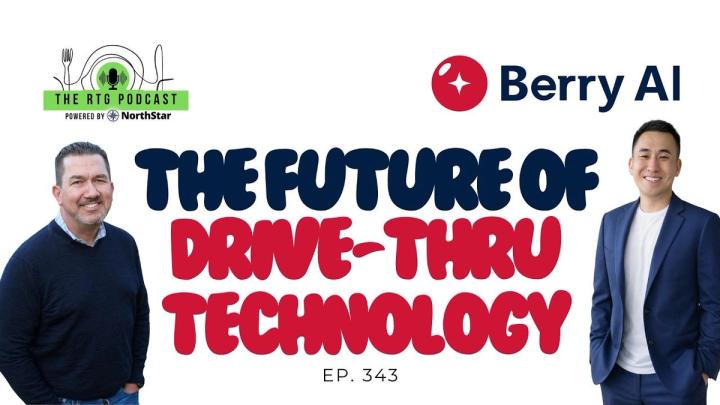
Berry AI CEO Eric Lam joined the Restaurant Technology Guys podcast (Ep. 343) to talk about the hidden flaws in how QSRs have measured drive-thru speed for 30 years — and how computer vision is changing the game.
If you run a drive-thru, you already know the math: every seven seconds you shave off your speed of service translates to roughly 1% more revenue. What you may not know is how easy it is to fool the sensors most operators still rely on to measure it.
That was the starting point when our CEO, Eric Lam, sat down with Jeremy Julian on the Restaurant Technology Guys podcast. Over the course of the conversation, they dug into the three critical flaws of loop timers, when pull-forwards are good operations versus metric manipulation, how Berry AI handles privacy, and the news behind Culver's decision to deploy Berry AI nationwide.
Here are the highlights.
Speed of service is a revenue lever, not a vanity metric
Consumers have been trained not to wait. As Eric put it on the show: "We live in an era where we've been spoiled to not wait for things... the difference between a four-minute wait and a five-minute wait might mean next time you're hungry, you don't go to that establishment."
For QSRs, that impatience compounds across thousands of transactions. Faster lines don't just improve today's throughput — they convince guests to come back more often. That's why nearly every major brand ties store bonuses to speed-of-service targets. Which is exactly where the trouble starts.
The three flaws of loop timers
For three decades, drive-thru timing has been measured by loop timers — magnetic inductive loops buried under the pavement that act as metal detectors when a car stops over them. The technology is mature, but it has three structural problems:
1. They only measure two points. Because installation means digging up concrete, loop timers typically sit at just the menu board and the pickup window. The customer's journey actually starts the moment they join the queue — a journey with six or seven meaningful data points that two sensors simply can't see.
2. They're easy to game. When bonuses are tied to loop timer numbers, staff get creative. Eric shared real examples from the field: employees waving metal trays over the sensor to trigger faster reads, or pulling cars forward off the loop so the timer stops while the guest keeps waiting in a parking spot.
3. They're expensive to maintain. Snow and weather damage the loops, and repairs mean shutting down the drive-thru and digging up pavement. They also lock you into one fixed lane configuration — a real limitation as brands experiment with dual-lane and dynamic drive-thru layouts.
How computer vision closes the gaps
Cameras solve each of these problems by design. Berry AI stitches together views across multiple cameras so the timer starts the moment a car enters the queue and keeps tracking through ordering, pickup — and even a pull-forward. For the first time, operators can measure true end-to-end guest wait time, which is what the customer actually experiences.
And cameras can't be fooled. A waved metal tray does nothing. A car pulled forward keeps being tracked until the food actually arrives.
Pull-forwards: good ops or gamed metrics?
Not every pull-forward is manipulation. Pulling a car forward is the right call when that guest is going to have a long wait anyway — a six-person order, or a cook-to-order concept where food is only prepped after the guest orders — and holding them at the window would stall the whole line.
The problem is that loop timers can't tell the difference. Berry AI can. By combining drive-thru video with POS data in real time, the system distinguishes a legitimate pull-forward (long line behind a big order) from a flagged one (a car pulled forward at 10 PM with nobody behind them). Operators finally get an honest picture of both their speed and their operating discipline.
Actionable beats exhaustive: the "less is more" principle
Eric was candid that early on, Berry AI gave customers every metric imaginable — and inundated them. The lesson: less is more.
Today, that philosophy shows up in two ways. In-store, a real-time dashboard is designed to be understood with zero training — as intuitive as an IKEA instruction guide — so a crew member can glance up, see eight cars in the queue, and know they're about to run out of fries. In reporting, daily and weekly summaries boil down to the three or four metrics that matter, customized to each brand's own terminology, whether they call it "experience time," "total journey time," or something else.
"Our goal is not to get you to spend more time on our dashboard. Our goal is to make it so that you can get a quick glance and know what you need right away."
What about privacy?
A camera-based system raises a fair question: what about PII? Berry AI's answer is intentional restraint. The system doesn't do facial recognition or license plate reading — it doesn't need to. Knowing that a red car spent five minutes and thirty seconds in the drive-thru delivers the operational value without identifying anyone.
Berry AI goes one step further: video is processed on a server inside the restaurant, and once the AI has analyzed the journeys, the video is not stored. Anonymized, non-identifying use cases like this are regulated the same way standard security cameras are today.
The Culver's news — and what it signals
The conversation was timed around a major announcement: Culver's will deploy Berry AI to its restaurants nationwide this year — over 1,000 locations.
What makes the partnership notable is that Culver's wasn't upgrading from loop timers; they'd never used them. As a cooked-to-order brand expanding into new markets where guests don't yet know that fresh food means a slightly longer wait, Culver's chose to leapfrog straight to computer vision — starting with small pilots, incorporating franchisee feedback, and scaling from there.
Where this goes next
Eric described Berry AI's roadmap in three chapters. Chapter one — the drive-thru timer, now proven with brands like Culver's and Zaxby's — is complete. Chapter two, driven by customer demand, is unifying drive-thru AI and in-store security cameras into a single system, so a slow daypart can be investigated with one click into kitchen footage. Chapter three is the big one: using cameras to automate the hundreds of manual audits that nobody signed up for — fry hold times, table cleanliness, inventory deliveries — so staff can spend their time on hospitality instead of checklists.
Listen to the full episode
There's much more in the full conversation, including Eric's journey from his family's POS manufacturing business to Harvard Business School to founding Berry AI.
🎧 Listen on Apple Podcasts or Spotify, or watch on YouTube.
Ready to see what your drive-thru is really doing? Berry AI works with QSRs of every size — most brands start with a pilot at one or two locations. Get in touch for a demo →