


Running a QSR has never been simple, but the last few years have added a new level of complexity.
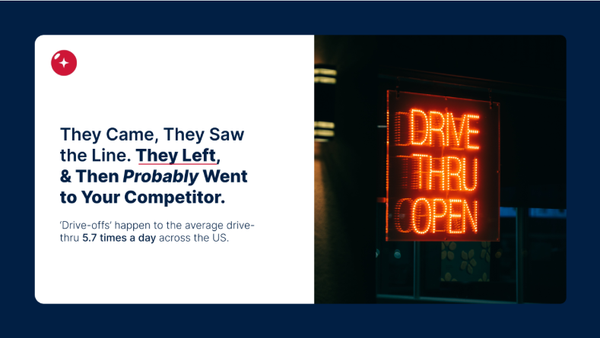
Sales are projected to reach $1.55 trillion, but much of that growth is being driven by price increases rather than increased traffic. Drive-thru traffic has also declined in recent years, even as other channels grow. That reflects a broader shift in how consumers are interacting with restaurants, as noted by QSR Magazine.
Operators are balancing more variables than ever. Consumer behavior is changing, labor costs are rising, menus are getting more complex, and competition is expanding beyond traditional restaurants into convenience stores and prepared grocery.
That pressure is one of the reasons AI and automation are getting more attention. At the same time, adoption is still early. Although thousands have deployed vision AI, that is still a small percentage of overall operators. As interest continues to grow, those levels of adoption continue to increase.
Across conversations at MURTEC, one theme came up repeatedly. Operators are no longer asking what AI can do today. They are asking what it should be able to do next.
Operator Expectations for AI Are Moving Beyond Today’s Capabilities
In one conversation, an operator described it simply: “I’m ready for it to personalize the drive-through experience. So we can start the order by saying: ‘Hi Jan, will you be having the normal today?’”
The idea had shifted from novelty to base expectation. It’s now time for systems that recognize customers, understand behavior, and respond in real time.
The new question isn’t about whether AI works, it’s about how far it can go.
In another conversation, a CTO put it more bluntly: “I don’t really care about speed of service. I want to know if AI can tell me if a pickle is on a sandwich when it shouldn’t be.”
This is a different level of expectation. Not general visibility or reporting, but precision. Maybe more importantly, these are not incremental improvements. They reflect a new age of AI expectations, with many of those expectations still being far from market-ready.
From Early-Stage AI to the Next Phase of Visual Intelligence
What stood out to us was how quickly conversations moved beyond basic adoption.
There was little focus on whether AI should be implemented. The assumption was already there. The focus shifted to how deeply it could operate within the store.
This next phase of visual intelligence centers around systems that can interpret what is happening in-store, understand context, and operate at a level of detail that matches how stores actually run.
Earlier conversations around AI in QSR focused on automation and efficiency at a high level. What is emerging now is a push toward systems that operate with more nuance and closer alignment to how operators actually run their businesses.
Why AI Expectations Are Accelerating in Restaurant Operations
There is a reason these expectations are moving quickly. The operating environment has become more demanding. Restaurants are managing higher complexity with tighter margins.
Labor costs have risen, staffing remains a challenge, and menus are expanding with more customization. Ordering channels continue to grow, adding pressure to already complex workflows.
When teams are stretched, small issues become harder to catch and more costly when they slip through. Missed ingredients, incorrect orders, and inconsistent preparation are daily operational challenges. The idea of AI that can operate at that level of detail becomes more compelling in that environment.
So while some of the capabilities being discussed are still a few steps ahead of what is widely deployed, the demand for them is grounded in real operational needs.
What AI in QSR Still Needs to Solve Today
Even with that forward-looking thinking, the fundamentals have not changed.
Operators are still focused on speed of service, consistency across locations, and managing operations with smaller teams.
Most systems today are still helping teams understand what happened. Fewer are equipped to interpret what is happening in real time at a granular level.
That gap does not make the expectations unrealistic. It highlights where the industry is in the transition.
What the Future of AI in QSR Will Be Built Around
What came out of MURTEC was not just a set of interesting conversations. It was direction.
The types of questions operators are asking point toward a different expectation of AI. Not as a reporting layer, but as something closer to operational understanding. That shift matters because it influences how technology gets built. When expectations change, roadmaps follow.
The conversations around visual intelligence are already pointing toward a phase where systems are expected to operate with far greater precision and context.
That direction is already taking shape. The technology will catch up.