

Not every vision AI use case is created equal. And as many of our industry friends know, the ones that fail brand-wide have alarm bells blaring early on, especially if you know where to look.
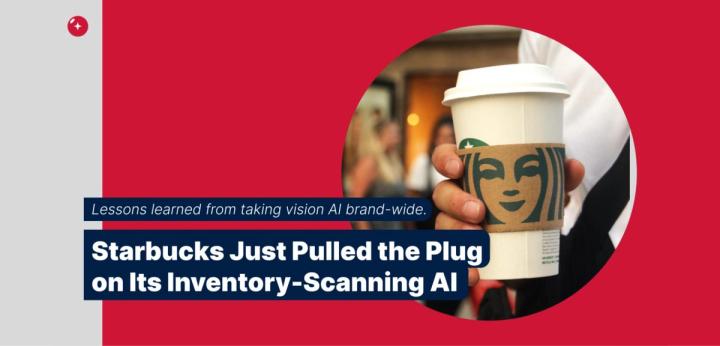
Starbucks is one such case. The company recently pulled the plug on its inventory-scanning AI, roughly nine months after rolling it out nationwide. When the program launched, it was held up as “one of the first vision AI use cases to go brand-wide in quick-service restaurants” — a major signal that computer vision had matured enough to run in every store.
So what happened? Reporting points to two issues. First, ongoing accuracy problems: employees reportedly found the system unreliable. Second, the difficulty of keeping the system trained as new items were added and existing ones were repackaged.
The real test of vision AI is what happens when you take it from a controlled pilot to hundreds of restaurants. But chin up — the failure modes are predictable enough that you can screen for them before you commit.
Neither issue comes as a surprise. They line up almost exactly with a framework we’ve been sharing with QSR operators for over a year. The lesson here isn’t “vision AI doesn’t work.” That’s not the case one bit. It’s that the difficult use cases announce themselves in advance.
Why inventory counting is one of the hardest vision AI problems
It’s tempting to assume that if a camera can read a drive-thru lane, it can count what’s on a shelf.
In practice, inventory counting is one of the most difficult vision AI challenges there is, for two very frustrating reasons.
Visual diversity. Shelves are messy. Items sit at odd angles, overlap, get obscured, and look different under different lighting. The visual “vocabulary” the model must master is enormous — and it varies store to store.
Constant change. Items get added, discontinued, and repackaged all the time. Every change is something the model has never seen, so the system needs ongoing retraining just to stay level. A use case that depends on visual cues that change frequently — like product packaging — quietly generates maintenance work forever.
Neither issue gets easier with scale. Across hundreds or thousands of locations, keeping the system accurate means accounting for all that variation while continuously adapting to what changes.
Two questions to ask before you go brand-wide
If you’re an operator evaluating a vision AI deployment, here are the two things we’d push hardest on.
Did the pilot actually test the diversity of your stores? A pilot that succeeds in a handful of clean, well-lit, well-run locations tells you almost nothing about how the system behaves across your whole fleet.
Our rule of thumb: expand pilots to 20+ locations before committing brand-wide — and make sure those stores cover the true diversity of your network.
A more aggressive approach is to deliberately pick your hardest stores for the pilot. Spot the ones with the worst lighting, messiest layouts and most edge cases. If the system holds up there, you have real confidence. If it doesn’t, you’ve learned it cheaply. Most operators can’t tell which stores are “hardest” for a vision system — and that’s a great test of your vendor. A good partner welcomes that conversation.
How much retraining will this really require? If the use case relies on visual cues that change often, dig into the vendor’s retraining and maintenance capabilities first. Ask directly: when a new item launches or packaging changes, what has to happen, who does it, how long does it take, and what does accuracy look like in the meantime? Constant retraining isn’t disqualifying (however frustrating) — but it needs to be priced in, staffed for, and owned by someone.
There’s a reason we call these things pilots
You test. You find the weird stuff. You figure out what holds up and what doesn’t. Sometimes you scale it. Sometimes you kill it. Starbucks took a swing at a genuinely difficult use case and got an answer. That answer just happened to be “not this one.” And frankly, that’s still useful progress.
“Starbucks made a reasonable bet on a genuinely hard problem, and pulling the system when it wasn’t working is arguably the right call — not a failure of nerve. The real lesson for the rest of the industry is about selection: choosing use cases whose difficulty you understand, pressure-testing them against your hardest stores, and choosing vendors who are honest about where the limits are. At Berry, this is the discipline we bring to every deployment — which is why more QSR brands are trusting camera-based systems to run in every one of their restaurants, not just a few.” — Eric Lam, CEO, Berry AI