

If restaurant headlines are to be believed, we’re only a few product launches away from having AI take your order, a robot cook your food, and a drone drop it in your backyard. Whether that timeline proves accurate or not, the pace of innovation can make it feel like QSR suddenly appeared in the age of AI.
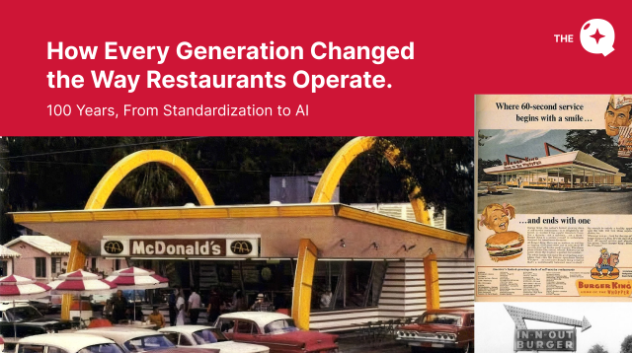
In reality, the industry has spent more than a century reinventing itself. The industry’s earliest pioneers had to convince customers that standardized food could be trusted. The next generation figured out how to scale restaurants across America. Then came decades of optimizing every second, every labor hour, and every transaction.
Every era of quick-service restaurants has been defined by a different operational problem. Once operators solved one challenge, an entirely new one emerged. Looking back at that progression doesn’t just tell us where the industry has been. It also offers some clues about where it’s headed next.
The First Challenge: Earning America’s Trust
The Early Years (1900-1948) | Before restaurants could scale, they had to earn consumers’ confidence.
The earliest quick-service restaurants weren’t trying to shave seconds off service times or optimize labor costs. They were trying to solve something much more fundamental: convincing people their food was safe to eat.
At the turn of the 20th century, hamburgers were a far cry from the American staple we know today. They were commonly associated with street vendors and traveling fairs, where quality and sanitation varied widely. Public confidence took another hit in 1906 when Upton Sinclair published The Jungle. Although the novel was intended to expose the harsh realities of the meatpacking industry, it instead sparked widespread concern about food safety and helped lead to the passage of the Meat Inspection Act and the Pure Food and Drug Act that same year.
The industry suddenly had a trust problem. That environment created an opportunity for a different kind of restaurant.
When White Castle opened in Wichita, Kansas in 1921, its main product was consistency. The buildings were intentionally clean and recognizable, the menu was simple, and the cooking process was standardized so customers knew exactly what they would receive every time they visited. That philosophy laid the groundwork for what came next.
In 1948, the McDonald brothers introduced the Speedee Service System in San Bernardino, California. Instead of organizing a kitchen around individual cooks, they reorganized it around a carefully designed assembly line. By reducing the menu and standardizing every step of production, they dramatically increased both speed and consistency, creating an operating model that would eventually define the modern quick-service restaurant. The industry’s first breakthrough was proving that standardized food could earn the public’s trust.
Once operators solved that problem, the next challenge became: how do you deliver that same experience to millions of people across an entire country?
The Expansion Era: Building at Scale
Post-War Boom (1948-1980) | Once restaurants earned customers’ trust, the next challenge was bringing that experience to every highway exit in America.
By the late 1940s, operators had proven that standardized restaurants could work. The challenge was no longer convincing customers to walk through the door, it was figuring out how to put that same experience within reach of millions more.
Fortunately for the restaurant industry, America was expanding just as quickly.
Suburbs were growing, car ownership was becoming the norm, and in 1956 President Dwight D. Eisenhower signed the Federal-Aid Highway Act, launching the construction of more than 41,000 miles of interstate highways. Suddenly, Americans were traveling farther and eating away from home more often than ever before.
Restaurants evolved alongside those habits. Drive-ins gradually gave way to drive-thrus. Franchising became the dominant growth model. Chains like Burger King, KFC, Taco Bell, and Wendy’s expanded rapidly, proving that one successful restaurant could become hundreds, or even thousands, without fundamentally changing the customer experience.
For the first time, scale became the industry’s competitive advantage.
Success was easy to measure. More restaurants meant more customers, more revenue, and a larger share of the market. If a brand was winning, you could literally watch it happen as new locations appeared along highways and in growing suburbs across the country.
It was an era defined by physical expansion. The industry’s biggest challenge here was simply building more of them. By the end of the 1970s, many of the country’s largest brands had accomplished exactly that.
The Optimization Era: Running Better Restaurants
The Digital Revolution (1980-2020) | Once restaurants reached every corner of the country, the next challenge became making every location perform better.
National expansion didn’t stop in the 1980s, but it was no longer the only path to growth.
Most major QSR brands had already established a national footprint, and competition shifted from opening the most restaurants to operating the best ones. Margins were tightening, customer expectations were rising, and operators were looking for ways to improve speed, consistency, and profitability without simply adding more locations.
Technology became the answer. Over the next four decades, restaurants invested heavily in systems designed to improve operations.
- Point-of-sale systems replaced handwritten tickets.
- Kitchen display systems improved communication between the front and back of house.
- Labor scheduling software made staffing more predictable, while inventory management tools helped reduce waste and control food costs.
- As the internet and smartphones reshaped consumer behavior, loyalty programs, digital menu boards, mobile ordering, and third-party delivery platforms gave customers entirely new ways to interact with restaurants.
Together, these technologies transformed how restaurants operated. Managers no longer had to rely solely on instinct or end-of-day reports to understand performance. They could track ticket times, labor utilization, sales mix, inventory, customer purchasing patterns, and dozens of other operational metrics.
Decisions that were once based on experience increasingly became informed by data.
The results were significant. Restaurants became faster, more efficient, and more consistent than ever before. Small operational improvements could be tested, measured, and rolled out across hundreds or even thousands of locations, creating meaningful gains at scale.
But by the end of the 2010s, operators found themselves facing a different kind of challenge. Restaurants weren’t short on information anymore. In many cases, they had more operational data than they knew what to do with. Point-of-sale systems, loyalty platforms, labor software, delivery providers, and drive-thru timers were all generating valuable insights, but they often lived in separate systems and answered only part of the story.
Collecting data had become relatively easy. Turning that data into a clear understanding of what was actually happening inside a restaurant would define the industry’s next chapter.
The Intelligence Era: Turning Visibility into Action
The AI Era (2020-Today) | Restaurants don’t just need more data. They need a better understanding of what’s actually happening.
Today’s restaurant operators have access to more information than at any other point in the industry’s history.
A single restaurant may have data flowing from its point-of-sale system, loyalty platform, labor scheduling software, inventory management system, online ordering providers, third-party delivery services, and drive-thru timers. Managers can see sales by the minute, labor costs by the hour, customer purchasing habits, delivery performance, and countless other metrics that simply weren’t available a generation ago.
Ironically, having more information hasn’t necessarily made running a restaurant simpler.
It’s a challenge most of us recognize in our own lives. We have nearly unlimited information available every day, yet finding the answer we actually need often feels harder than ever. The problem isn’t access to information anymore, it’s filtering out the noise, understanding what’s relevant, and connecting ideas that don’t obviously fit together.
Restaurants have reached that same point.
Most operators aren’t asking for another dashboard or another report. They’re trying to understand what all of their existing systems are collectively telling them.
A legacy loop timer might show service slowed during lunch, but it can’t explain why. Labor reports can show staffing levels, but not whether employees at the window were waiting on food to be cooked. Point-of-sale data can show when an order was completed, but not what happened between the speaker post and the pickup window.
That’s why the conversation around AI has shifted so dramatically over the past few years.
Rather than simply automating individual tasks, the newest generation of restaurant technology is increasingly focused on connecting information, identifying patterns, and giving operators visibility into the operational story behind the numbers.
Instead of asking “What happened?” restaurants are beginning to ask “Why did it happen?” and “What should we do about it?”
In many ways, that’s the biggest change this era has introduced.
Like every era before it, the technology itself will continue to evolve. But the underlying challenge feels familiar. The industry’s biggest opportunities have never come from adopting technology for its own sake, they’ve come from solving the next operational problem.
What’s Next?
The Next 5-10 Years | The biggest changes may not come from new technology, but from changing customer expectations.
After spending the last few weeks looking back at more than a century of QSR history, we wanted to finish by looking forward. So we asked our VP of Revenue, Rob Green, a simple question: “Do you have any predictions for where the QSR industry will be in five or ten years?”
He laughed and said “No way.” And added: “I couldn’t realistically do that in terms of five years out. I think we’re always anticipating change is going to happen faster than it actually does.”
Rather than trying to guess what restaurants will look like a decade from now, Rob pointed to the changes he’s already watching happen today.
The first is mobile ordering. Through Berry’s work with operators, he’s already seeing brands rethink the traditional drive-thru. He pointed to Chick-fil-A’s dedicated mobile pickup lane as an example, where customers order ahead, scan a code, pick up their food, and leave with very little interaction. As he put it, “Convenience is going to look different.”
He also doesn’t believe every brand will evolve in the same direction. Some restaurants will continue simplifying menus and operations, while others will double down on hospitality and menu variety because that’s what their customers expect. The future of QSR won’t be one operating model replacing another, it will be operators becoming even more intentional about delivering the experience their customers actually want.
Finally, he said he expects restaurants to keep experimenting with formats that better match how people order today. Ghost kitchens and delivery-first concepts won’t replace traditional restaurants, but they will continue expanding the industry’s definition of what a restaurant can be. As customer behavior changes, operators will keep adapting alongside it.
So now we’ll turn the question over to you: what do you think will define the QSR industry in 2030?