

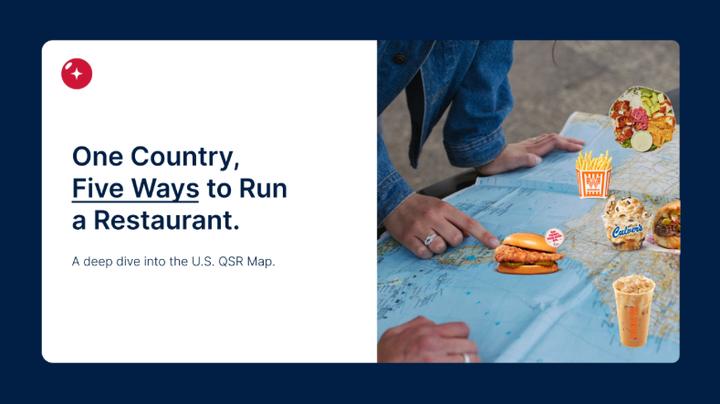
Every region has its thing.
The Northeast runs on coffee. The Southeast debates chicken chains like sports teams. Texas has strong opinions about breakfast tacos. And if you’ve ever tried to tell someone from the Midwest that Culver’s is “just another burger place,” you already know how that conversation ends.
While we often talk about the U.S. QSR industry as one market, the data suggests something more nuanced. Consumer preferences shift across the country, and over time those differences have influenced the brands, operating models, and competitive dynamics that define each region.
Looking at the industry through that lens reveals five distinct regional patterns hiding inside one national market.
Northeast: Where Convenience Comes First
Nobody enjoys navigating downtown Boston at lunchtime… or Manhattan… or Philadelphia.
The Northeast has always rewarded operators that can get customers in and out quickly, often on foot, between meetings, trains, or the next stop in the day. That’s why many of the region’s defining brands grew around coffee, breakfast, and grab-and-go occasions rather than sprawling dining rooms or massive drive-thrus.
Convenience became the product just as much as the food.
Today that philosophy has evolved into mobile ordering, urban pickup shelves, compact restaurant formats, and delivery networks designed around density. It’s no coincidence that brands like Dunkin’ became institutions here.
You can still see the results of that operating philosophy. The Northeast posted 0.9% same-store sales growth in 2025, behind the Midwest and Southeast, but ahead of the West Coast. It isn’t the fastest-growing QSR region in the country, but that’s partly because it doesn’t need to reinvent itself every few years. Decades of optimizing for convenience have produced an operating model that’s remarkably resilient.
Midwest: Where Consistency Is Everything
People joke that Midwesterners will drive twenty minutes to save five dollars, but there’s another stereotype that’s just as true: they know exactly what they’re going to order before they walk through the door.
The Midwest has never been a region that favored constant reinvention. It rewarded restaurants that could deliver the same experience every single time.
That’s why brands like Culver’s and Portillo’s built loyal followings around quality, hospitality, and dependable execution instead of chasing the next menu trend. For operators, consistency wasn’t just a nice-to-have — it became the competitive advantage.
That philosophy is still paying dividends today. The Midwest led the country in 2025 same-store sales growth at +1.5%, with states like South Dakota (+4%) and Ohio (+2%) among the strongest performers. At a time when many restaurant brands are searching for the next big innovation, the Midwest is a reminder that operational excellence still wins.
Southeast: Where Speed & Hospitality Are Paramount
Nobody takes their drive-thrus more seriously than the Southeast.
In much of the region, getting in the car isn’t just one way to grab lunch — it’s the way. Lower-density suburbs, longer commutes, and car-centric communities meant QSRs had to figure out how to serve a constant stream of vehicles without sacrificing the experience.
That pressure shaped some of the industry’s most recognizable brands: Chick-fil-A, Zaxby’s, and Bojangles. There’s a reason these names come up when operators talk about great drive-thrus. In the Southeast, the drive-thru wasn’t an add-on to the restaurant — it was the restaurant. Brands that couldn’t execute it simply didn’t last.
In one recent Berry deployment with a four-store Georgia Zaxby’s operator, nearly 70% of revenue came through the drive-thru, making every second in the lane directly tied to the day’s performance.
Today, that philosophy continues to define the market. The Southeast posted +1.3% same-store sales growth in 2025, with Florida (+4%), Georgia (~+2%), North Carolina (~+2%), and Tennessee (~+2%) all outperforming many parts of the country. As customer expectations continue to rise, the challenge is no longer just moving cars faster — it’s creating faster, more consistent experiences without losing the hospitality that made many of these brands successful in the first place.
Texas & Southwest: Where Customization Is the Standard
Texas is big enough to be its own restaurant market, but we’re looking at it alongside the broader Southwest because both regions developed remarkably similar operating philosophies.
If the Southeast perfected the drive-thru, the Southwest perfected saying, “Can I make one change?”
Today it’s common to have apps that remember your favorite order or loyalty programs powered by personalized offers. The Southwest was years ahead of the game, built around flexibility from the jump with bigger menus and made-to-order meals.
It’s one of the reasons brands like Whataburger built such loyal followings. Customization wasn’t treated as an inconvenience or a premium feature. It was part of the experience, which meant operators had to build kitchens and processes capable of handling complexity without slowing everything down.
Texas remains one of the fastest-growing states in the country, adding more than half a million residents between 2023 and 2024 — the largest population increase of any state — fueling continued restaurant expansion and introducing even more diverse customer preferences.
Brands like Whataburger are doubling down alongside this growth. As Chief Marketing Officer Scott Hudler recently put it, “Personalization has always been at the core of our brand identity.” Now it’s time to scale it.
West Coast: Where New Ideas Get Their Start
The West Coast has always had a habit of trying things before everyone else.
From avocado toast to electric cars and standing desks, they are the innovators. Whether the rest of the country eventually embraces them is another conversation, but new ideas tend to show up here first. Restaurants have been no different.
Premium burgers. Specialty coffee. Plant-based menus. Mobile ordering. Restaurant robotics. AI. If you’ve seen a major shift in quick-service restaurants over the last few decades, there’s a good chance it gained traction somewhere on the West Coast before making its way across the country.
Brands like In-N-Out Burger, Sweetgreen, and more recently Dutch Bros Coffee all reflect that willingness to challenge what quick-service restaurants can look like. The region has consistently rewarded operators willing to experiment, even if the ideas don’t always work the first time.
That willingness to experiment continues today, but it also comes with some of the industry’s toughest operating conditions. The West Coast averaged just +0.3% same-store sales growth in 2025, the lowest of the five regions, while California posted negative same-store sales in eight of the twelve months measured. Innovation may start here, but proving it can scale is a very different challenge.
One Industry, Five Operating Environments
Maybe this shouldn’t be surprising. Different regions weren’t trying to build different restaurant industries — they were simply solving different problems.
Those solutions were shaped by geography, customer expectations, and decades of operators adapting to the markets they served. Over time, they became operating philosophies that still influence how restaurants compete today. That’s why thinking about the United States as a single QSR market can be misleading. It may be one industry, but it’s made up of very different operating environments, each rewarding something different.
The takeaway isn’t that one region got it right and another got it wrong. It’s that every region became exceptionally good at solving slightly different operational challenges.
Which raises an interesting question: as regional brands expand nationally, do these operating philosophies start to disappear, or do they become the very thing that helps those brands win?