

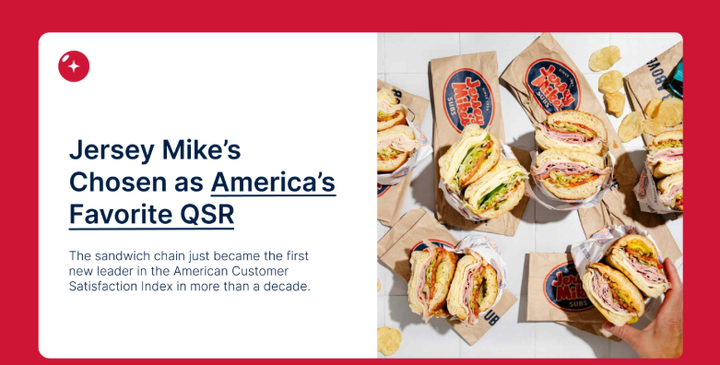
Jersey Mike’s Subs has had a remarkable few years.
The sandwich chain recently became the first new restaurant to top the American Customer Satisfaction Index’s quick-service rankings in more than a decade, earning a score of 84/100 based on more than 16,000 customer surveys.
While many growing restaurant brands eventually see operational performance flatten, or even decline, Jersey Mike’s has continued improving while adding more than 1,000 net new restaurants over the past four years.
Its average unit volumes have continued climbing. Same-store sales have now grown for 20 consecutive years. Customer satisfaction has improved enough to become America’s highest-rated QSR.
Preventing operational complexity from outpacing operational consistency like that is an unusually difficult thing to pull off.
The Growth Trap
Growth doesn’t usually fail all at once — it slowly becomes harder to manage.
Restaurant leaders spend a lot of time talking about growth, but growth creates its own operational challenges. Every additional restaurant means more managers, employees, digital orders, variability, and more opportunities for execution to become inconsistent. Eventually, many brands reach a point where adding restaurants becomes easier than maintaining the standards that made them successful in the first place.
Jersey Mike’s appears to have avoided that trap.
Since 2006, the company has increased average unit volume every single year, growing from roughly $423,000 to $1.36 million in 2025. Systemwide sales also increased from $3.7 billion in 2024 to $4.2 billion in 2025.
For a brand that now operates more than 3,200 restaurants, that’s sustained operational performance.
About a year ago, Jersey Mike’s leadership reportedly noticed something concerning. Small operational warning signs were beginning to appear: cleanliness wasn’t as consistent, some restaurants were shutting grills down early. Nothing catastrophic, but enough to recognize that growth was beginning to put pressure on execution.
Instead of continuing business as usual, the company reportedly paused parts of its national expansion, refunded franchise fees, and shifted its attention back toward training before accelerating growth again. That’s a decision that rarely makes headlines. It probably should.
The willingness to slow expansion in order to protect operational standards may be one of the biggest reasons the company has been able to continue growing without sacrificing customer experience. The takeaway: growth doesn’t create great operations. Great operations make sustainable growth possible.
Building Capacity Before Adding Complexity
The company invested in existing restaurants — not just new ones.
Another detail that stands out is where Jersey Mike’s invested. Digital ordering has grown from roughly 15% of sales before the pandemic to around 40% today.
Rather than simply opening more restaurants to absorb that demand, the company invested inside existing ones: dedicated digital make lines, updated counters, store remodels designed specifically to improve throughput.
In one group of remodeled Los Angeles restaurants, those investments reportedly helped drive a 30% increase in sales, compared to roughly 15% at locations that hadn’t yet been updated.
It’s an important reminder that scaling isn’t always about building more capacity, sometimes it’s about making the capacity you already have work better.
Growing With People Who Already Know the System
Expansion becomes easier when experience scales alongside it.
One of the most overlooked parts of this growth story isn’t how many restaurants it has opened, it’s who has been opening them.
Roughly 85% of the company’s recent expansion has come from existing franchisees. At the same time, Jersey Mike’s has continued investing in its internal Coach Program, helping successful managers and assistant managers become franchise owners themselves. That’s a different approach than simply recruiting as many new operators as possible.
As restaurant systems grow, maintaining consistency becomes increasingly difficult. Expanding with people who already understand the brand’s standards, culture, and operating model reduces that learning curve and helps preserve the consistency that customers expect.
It’s a reminder that scaling isn’t just about adding restaurants. It’s about scaling experience, operational knowledge, and leadership alongside them.
“One of the biggest mistakes growing brands make is assuming every new location is a real estate decision. In reality, it’s a people decision. The operators you choose to grow with often determine whether expansion strengthens the system — or stretches it too thin.” — Rob Green, VP of Revenue, Berry AI