

There have been a lot of quiet conversations happening across the QSR space lately.
Not headlines or earnings calls. The kind of conversations operators have behind the scenes when patterns stop lining up the way they used to.
From what we are hearing, something feels off.
On paper, the industry looks strong. The U.S. restaurant market is projected to surpass $1.5 trillion in sales, according to the National Restaurant Association. But underneath that, some of the most important signals are moving in a different direction.
Traffic from lower-income consumers, historically the most reliable QSR customers, is declining. At the same time, menu prices have continued to climb, with some chains seeing double digit increases over the past few years, according to QSR Magazine.
And while higher-income diners are starting to trade down into QSR, it is not a clean replacement. It is a different customer type, with different expectations, entering a system that was not designed for them.
That mismatch is starting to cause a shift. And it may be creating a bigger loss than most brands have fully accounted for.
Who QSR Was Built For
To understand what is changing, it helps to look at how the model started.
One of the earliest QSR concepts in the U.S., White Castle, was founded in 1921 with a simple premise: affordable, standardized food that could be served quickly and consistently to working-class customers.
That foundation carried forward as brands like McDonald’s scaled the model. Speed, price, and predictability became the core of the system.
The business was designed around a specific type of customer: highly price sensitive, visiting frequently, and prioritizing convenience over experience.
Volume made everything work. Margins were thin, but frequency and consistency made the model reliable. For decades, that equation held.
The Shift Happening Now
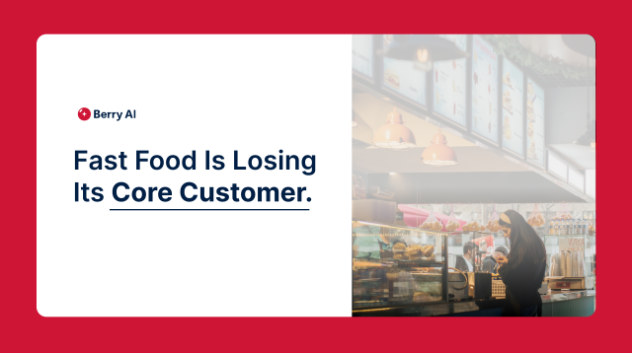
That core customer is starting to pull back.
Rising prices have hit lower-income consumers the hardest, and they are adjusting. Visiting less often. Spending more selectively. In some cases, opting out of QSR altogether.
Some are shifting toward alternatives like convenience stores, where prepared food quality has improved and price points can feel more accessible. At the same time, a different customer is entering the category.
Higher-income diners, priced out of or fatigued by casual dining, are trading down into QSR. But they do not behave the same way: they visit less frequently, they expect higher quality and consistency, and they are less forgiving of operational friction.
So while traffic may look stable at a high level, the behavior underneath it is changing.
QSR did not just lose a customer. It replaced them with one that requires a different way of operating.
How Operators Are Responding
We asked Berry AI’s VP of Revenue, Rob Green, how he is seeing operators respond. His answer was straightforward: “Brands are leaning into value-oriented offerings to reattract their lost clientele. It is a way to stabilize traffic and appeal to a broader range of customers entering the category.”
But that is not solving the core issue. “Value meals might keep people coming in, but they don’t fix the margin problem, especially when costs are already tight,” he said.
These strategies can help prevent further decline. They do not fundamentally change the economics. And that is where his second point matters more.
“When the tide goes out, you discover who’s been swimming naked.” - Warren Buffett
As pricing pressure increases and customer behavior shifts, inefficiencies become harder to hide.
Stores that have been running tight operations, strong throughput, and consistent execution are better positioned to absorb the change. The ones that have not are going to feel it quickly.
What Comes Next
If this shift continues, QSR will not look exactly the same as it does today. Not because the model disappears, but because the standard for execution gets higher.
Speed is not going away. If anything, it becomes more important. But it is no longer just about how fast a car clears the window. It is about how smoothly the entire operation runs, from the moment a customer enters the lot to the moment they leave.
That is where the pressure is building. The original customer still expects speed and affordability. The new customer expects speed, but also consistency and a lack of friction across the entire experience. Both are less forgiving than before.
Which means operators are no longer optimizing a single metric. They are being forced to understand where time is actually lost, where bottlenecks form, and how small inefficiencies compound across the full system. That is the shift.
Not just who QSR serves, but how precisely it needs to operate to serve them.
The brands that figure out how to run a clean, consistent operation from end to end will have an advantage. The ones that continue to manage speed as a single number may miss where the real problems are forming.