

At Berry AI, we use vision AI technology to help quick service restaurants see and understand what’s happening inside their operations. That means we spend a lot of time looking at what’s happening at the counter, the drive-thru, and everything in between: how demand shows up, where things slow down, and where execution starts to break. Over time, you start to notice patterns.
There’s a lot of conversation happening at a high level, with new campaigns, changing customer behavior, and different ways brands are driving traffic. And a lot of it is interesting. But when that demand actually hits a store, especially during a rush, it doesn’t always play out the way it was intended to. That gap is where things usually get more complex.
For years, QSR competed on price alone. That’s changing.
Brands are now competing on cultural relevance thanks to the rise of social media. This shows up in limited-time drops, nostalgia-driven campaigns, and collaborations tied to movies, gaming, and social trends.
The goal now isn’t just to sell a meal. It’s to create a moment people want to be part of. And it’s working. Consumers are showing up not just because they’re hungry, but because something feels new, familiar, or worth sharing. You can see this clearly in what’s driving traffic for major QSRs now.
Campaign-Driven Moments Are Translating Into Real Demand
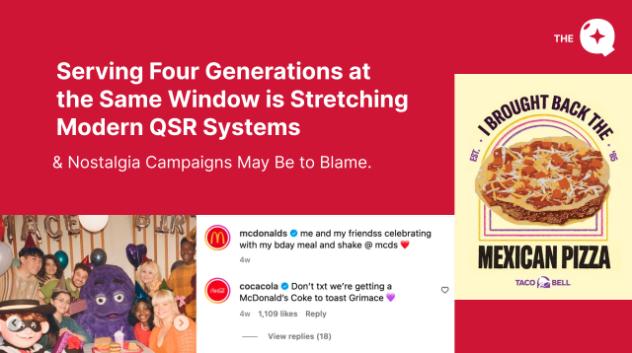
McDonald’s leaned into nostalgia with the Grimace Birthday Meal, and what started as a simple purple shake quickly turned into a full-scale TikTok trend, with users creating chaotic, viral content around it. The Cactus Plant Flea Market “Adult Happy Meal” drop didn’t just drive traffic, it created resale markets for the toys. And the Travis Scott Meal drove demand to the point where some locations ran out of core ingredients.
McDonald’s saw roughly 12% U.S. same-store sales growth during the Grimace campaign, while earlier celebrity LTOs like the Travis Scott meal drove double-digit revenue increases and even product shortages. This isn’t isolated. Across the industry, limited-time offers and cultural campaigns are consistently producing high single- to double-digit traffic and sales lifts.
Taco Bell has been running a similar playbook for years. The return of the Mexican Pizza, driven by fan and celebrity demand on TikTok, led to immediate sell-outs. Nacho Fries come back in cycles, and every time they do, they behave less like a menu item and more like a release. Even core products are now positioned as events.
These campaigns are generating concentrated demand, with sharp spikes in traffic rather than a gradual lift. Products sell out in days, kitchens get pushed, and stores are forced to adapt in real time.
One Window, Four Different Expectations
The Grimace campaign is probably the clearest example of how far this has gone. Within days, the shake became a social behavior. Millions of views, thousands of videos, and a level of engagement that had very little to do with the actual menu item. People weren’t just ordering it, they were performing it.
And this is where things get more complicated, because these campaigns don’t bring in one type of customer. They bring in all of them, often at the same time, for completely different reasons.
At a high level, the modern QSR customer isn’t a single profile, it’s a blend of generational behaviors that don’t naturally align.
Gen X and Millennials tend to respond to familiarity. Nostalgia works because it feels familiar. There’s a level of predictability in returning to something recognizable, whether that’s a revived character, a legacy menu item, or a campaign tied to something they already understand. Their expectation is still rooted in consistency: get in, get out, get what you expect, and in Millennials’ case, customize to desire.
Gen Z is operating on a different set of incentives entirely. Novelty matters more than familiarity, and timing matters more than consistency. If something is trending, they want to experience it while it’s relevant. If it’s not, they move on quickly. Social platforms play a significant role here, not just in discovery, but in validation. Food becomes content, and the visit becomes part of a larger social moment.
Then you have Gen Alpha, coming up behind them, who are growing up in fully integrated digital and AI environments. Their expectation isn’t shaped by campaigns as much as it is by systems. Ordering, customization, pickup; it’s all assumed to be seamless. They’re not comparing it to anything. They just notice when it doesn’t work.
What makes this more complex is that these aren’t isolated groups moving through the system separately. Increasingly, it’s the same customer shifting between behaviors depending on the moment. A quick, functional visit during the week can turn into a more experiential, higher-engagement visit days later. The variability isn’t just across customers, it’s within them.
Where the Operational Strain Starts to Show
Not every bottleneck is structural. Sometimes it’s a limited-time item turning into full-blown internet behavior.
This introduces spikes instead of steady flow. It brings in unfamiliar or limited-time items that disrupt routine. It increases customization. And it layers multiple ordering channels, drive-thru, mobile, in-store, on top of each other in ways that weren’t originally designed to work together.
That’s when friction shows up. Drive-thru lines slow down during peak moments. Kitchens get backed up trying to balance different order types. Accuracy drops under pressure, especially when new items are involved. Staff are forced into reactive decision-making without a clear view of what’s happening across the operation. The system itself isn’t broken. It’s just being asked to handle something it wasn’t built for.
And that’s really the shift.
Operators are still being measured on speed, accuracy, and consistency. Those expectations haven’t changed. But the environment those metrics sit in has. Demand is less predictable, customer expectations are higher, and the margin for error is tighter.
The industry has gotten very good at creating demand. Much faster than it has gotten at serving it consistently. Attracting four generations to the same brand is no longer the challenge. That part is working. Serving them, all at once, without something breaking, that’s where it gets difficult.
From the Field: How Vision AI Is Securing Consistency During Demand Spikes
So, where do we go from here? Do we just ride the wave of demand spikes with each campaign? We believe Vision AI is signaling another path.
Recently, we worked with a QSR operator to implement a vision-based system across their drive-thru and evaluate how a limited-time offer was impacting performance. With that visibility in place, they were able to pinpoint exactly where time was being lost as the spike came through and adjust in real time, adding support at the right moments, tightening handoffs, and preparing for the surge before it peaked.
Those changes translated directly into faster service and stronger overall performance.
It’s clear that when demand spikes from a campaign or limited-time drop, the advantage isn’t reacting faster, it’s knowing exactly where to act before things break.