


Berry AI's VP of Revenue, Rob Green, on why most fast food operators are flying blind, the hidden cost of drive-through inefficiency, and how profitable growth actually works.Rob Green has spent over a decade profitably scaling companies across technology and SaaS. At Berry AI, he leads go-to-market strategy for the QSR sector, helping brands move from reactive operations to data-driven revenue growth. He was recently featured on the Advance Your Talks podcast. There is a version of your drive-t
Berry AI's VP of Revenue, Rob Green, on why most fast food operators are flying blind, the hidden cost of drive-through inefficiency, and how profitable growth actually works.
Rob Green has spent over a decade profitably scaling companies across technology and SaaS. At Berry AI, he leads go-to-market strategy for the QSR sector, helping brands move from reactive operations to data-driven revenue growth. He was recently featured on the Advance Your Talks podcast.
There is a version of your drive-through that looks perfectly fine on paper. Window times are green. Managers are hitting their numbers. Bonuses are going out. And somewhere in the parking lot, a customer who waited too long just pulled out of your queue and decided to go somewhere else — and you have absolutely no idea it happened.
This is the gap Rob Green spends his days thinking about. As VP of Revenue at Berry AI, he works with QSR operators across the country who are realizing that what they can measure and what is actually happening in their business are two very different things. In a recent conversation on the Advance Your Talks podcast, Green laid out the framework he uses to diagnose revenue leaks, build efficient teams, and turn operational data into bottom-line growth — without spending a dollar more on marketing.
The Problem with Growth at Any Cost
The last decade created a generation of businesses optimized for revenue, not profitability. The logic was simple: show you can grow, attract the next round of funding, grow more. Profitability was a problem to solve later.
"When the free, cheap investor money dried up, it exposed the vulnerabilities of that business model," Green says. "Warren Buffett says when the tide goes down, you can see who's been swimming naked. A lot of companies were swimming naked."
"The whole point of business is to profitably add value to your customers in a way that they appreciate. If you can't do those three things, you shouldn't be in business." — Rob Green, VP of Revenue, Berry AI
The Metric That Actually Matters
Green uses one primary benchmark to assess the health of any revenue operation: the LTV to CAC ratio — the lifetime value of a customer relative to the cost of acquiring them.
"A lot of companies aren't paying any attention to that ratio. What you need is a minimum baseline of three dollars returned over the lifetime of the customer for every dollar you spend to acquire them. It doesn't mean they give you three dollars upfront — it can mean they buy one product now and two more over the next two years. But you need to make sure that ratio is in proper balance. When it's not, that's when you've got problems."
📌 The Benchmark: LTV:CAC Ratio
For every $1 spent acquiring a customer, a healthy business should generate at least $3 in lifetime value. When the LTV:CAC ratio falls below this threshold, growth becomes a liability rather than an asset.
Where QSR Operators Lose Revenue Without Knowing It
Green is direct about the most common blind spot he sees in the industry: operators investing in technology that does not directly affect the customer experience, while remaining unaware of what is happening in the part of the business that generates most of their revenue.
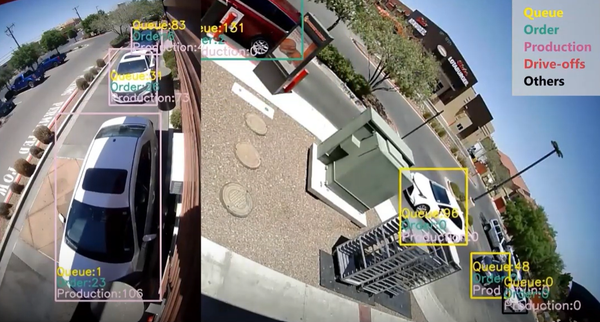
"Let's focus on the drive-through. Seventy percent of your revenue comes through your drive-through. If you can only see twenty-five percent of the customer journey, there is a lot of growth opportunity you are leaving on the table."
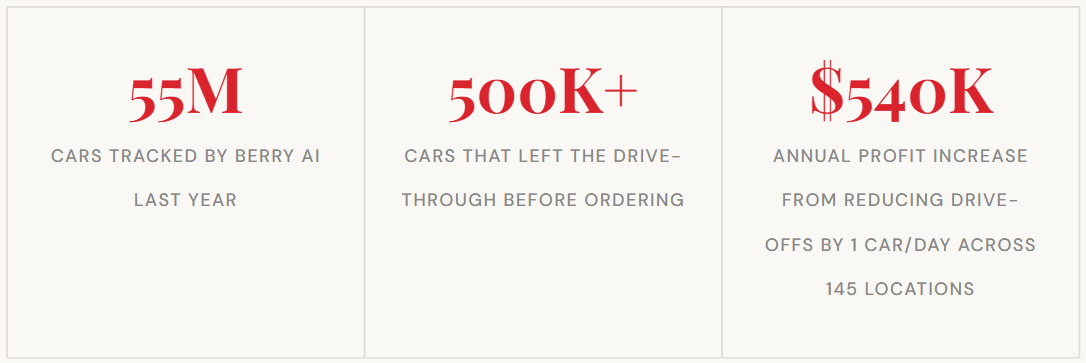
"Over half a million cars left the drive-through before they ever placed an order," Green notes. "You don't just lose that transaction. That customer remembers the place is too slow and goes somewhere else — and you lose all future revenue from them too."
The 3 Moments When Operators Invest in Visibility
1. When Sales Stall
Operators facing declining sales often assume the answer is more marketing spend. Berry AI consistently finds that the answer is operational — there are leaks in the existing funnel that, once identified and fixed, generate significant lift without additional advertising.
"Within the first week they identified a previously hidden bottleneck in their drive operations. They reassigned one worker to a different point in the workflow. Within 90 days, their weekly revenue had averaged between 13 and 20 percent higher. No additional marketing spend." — Rob Green
2. When Multi-Unit Owners Are Ready to Scale
Multi-unit franchise owners managing a portfolio of locations reach a point where legacy technology becomes a ceiling on what they can achieve. Upgrading visibility across a portfolio reveals patterns invisible at the individual store level — and creates a foundation for disciplined, profitable expansion.
3. When Brands Need to Move the Needle at Scale
National chains use Berry AI to understand how operational decisions ripple across an entire system — and to identify levers they can adjust to drive bottom-line results for every franchisee.
💡 Real-World Example
One national brand used Berry AI to analyze the speed-of-service impact of a new promotional menu item across all locations. The data revealed how much it slowed drive-through throughput — giving leadership the ability to make a fully informed decision about whether to keep it on the menu.
Building the Team That Makes It Work
Technology surfaces the problem. People fix it. Green is equally focused on how operators structure and motivate the teams responsible for acting on operational data.
"What I have found is that if you can create an environment where people feel like you are nurturing them and encouraging them to unlock their potential rather than trying to extract incremental productivity out of them, they will overproduce for you. People tend to stay and overperform in those environments."
"It doesn't matter whether you're inside my office, in Taiwan, or in the Czech Republic. As long as you can provide the deliverables, you've got an option." — Rob Green, VP of Revenue, Berry AI
3 Diagnostic Questions for Every QSR Operator
Green closed the conversation with a framework for any operator whose revenue growth has stalled. These are not strategic abstractions — they are the first questions he asks when he walks into a new engagement.
- Do I have the data I need to correctly assess the situation? Legacy technology gives operators a partial view — like flying a plane with only a fuel gauge and an altimeter. Before making any strategic decision, you need to know what is actually happening across the full customer journey.
- Where are the current leaks in my revenue funnel? The answer to a revenue problem is often not more marketing — it is plugging the holes in what you already have. Identifying where customers are dropping off can unlock growth without any increase in acquisition spend.
- What operational adjustments can I make now to retain my existing customers? A customer who drives off from your queue does not just cost you that transaction. They remember the experience, tell others, and you lose every future visit they would have made. Retention starts with operations — and operations start with visibility.
"In terms of leadership, I see it as our fundamental responsibility to care for the people entrusted to us — providing them with the support and opportunity they need to grow beyond their own expectations. If you do that effectively, your business can grow." — Rob Green, VP of Revenue, Berry AI
The most durable revenue growth in quick service does not come from the next marketing campaign or the next menu innovation. It comes from understanding, with precision, what is happening in the forty feet between where a customer joins your queue and where they receive their order — and having the operational discipline to act on what you find.
That is what Berry AI was built to make possible.
Ready to See What's Actually Happening in Your Drive-Through?
Talk to a Berry AI specialist about what complete customer journey visibility could reveal — and recover — at your locations.